 Important Notice:
Online registration is now CLOSED for this event. You can arrive up to one hour early to register at the door.



Presented by Peg Dawson, Ed.D., NCSP
Wednesday, October 30, 2019 – Thursday, October 31, 2019 | Ottawa, on
You are on the in-person registration page for this event. If you would like to attend online (live webinar or on-demand), please register through our Online Learning website.
Important Notice:Online registration is now CLOSED for this event. You can arrive up to one hour early to register at the door.
Wednesday, October 30, 2019 – Thursday, October 31, 2019
9:00am – 4:00pm
Holiday Inn – Ottawa East
1199 Joseph Cyr St., Ottawa, ON
Phone: 613.744.1060
Website: www.chimohotelottawa.com
Executive skills are sometimes called “the hidden curriculum.” They are skills such as task initiation, sustained attention, working memory, planning, organization, and goal-directed persistence that are absolutely critical to school success, yet curriculum standards seldom if ever explicitly reference these skills. Neuroscientists now tell us that these skills take a minimum of 25 years to reach full maturation, and the course of that development is influenced by experience and exposure, by modelling, practice, and direct instruction. This workshop will provide participants with a framework for understanding these key skills, how they develop in diverse populations, and how to support executive skills by embedding them into classroom routines and lessons and by tailoring interventions to meet the needs of individual students and classrooms.
Dear Colleague,
Many students struggle in school, not because they have problems acquiring academic skills but because they struggle with a key set of skills that underlie academic performance in a fundamental way. I’m referring to executive skills. Executive skills are critical to the acquisition of academic skills, but, more importantly, they are the skills students need to get things done. They are brain-based skills such as task initiation, sustained attention, working memory, planning, organization, and goal-directed persistence that are absolutely critical to school success. Some students seem to acquire them naturally, but many students don’t. This workshop, which offers intensive training in how to help these students, will provide a model for understanding what these skills are and how they develop. The primary focus of the workshop, though, will be to give participants the opportunity to practice an array of practical interventions that can be incorporated into the classroom or into clinical practice. If you have attended one of my 1-day trainings, this workshop will allow you to extend your learning by practicing strategies and applying those strategies to your setting and the students you work with. You will walk away with an understanding of interventions that you will be able to use the day after the workshop ends! Hope you will join me at the two-day skills training workshop!
Peg Dawson

Education and Clinical Professionals: K–12 Classroom Teachers, School Counsellors/Psychologists, Learning Assistance/ Resource Teachers, School Administrators, School Paraprofessionals including Special Education Assistants, Classroom Assistants and Childcare Workers. All other professionals who support students including but not limited to: Nurses, Social Workers, Psychologists, Clinical Counsellors, Family Therapists, Occupational Therapists, Speech Language Pathologists, Addiction Counsellors, Youth Workers, Mental Health Workers, Probation Officers, and Early Childhood Educators.
Parents, Caregiver, Foster Parents, Grandparents, and Extended Family raising a child.
DAY ONE
Overview of Executive Skills
Executive Skill Development Across the Lifespan
Assessment of Executive Skills
Modifying the Environment to Support Students with Weak Executive Skills
Audience activity: Brainstorm environmental modifications for each executive skill
DAY TWO
Teaching Executive Skills by Embedding Them in Daily Routines
Audience activity: Design a home or classroom routine that incorporates one or more executive skills
Embedding Executive Skills into Classroom Content-Area Lessons
Audience activity: Practice the process individually or in small groups
Designing Student-Centered Interventions to Address Specific Contexts Impacted by Weak Executive Skills
Audience activity: Using case examples provided or from the case load of participants practice designing student-centered interventions
Using Incentives to Encourage Practice
Classroom or Small Group Curricula for Teaching Executive Skills
Coaching
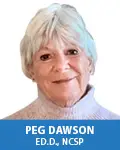
Dr. Peg Dawson: In over 40 years of clinical practice, Dr. Peg Dawson has worked with thousands of children who struggle at home and in school. At the center of their struggles are often weak executive skills. Along with her colleague, Dr. Richard Guare, she has written numerous books on this topic for educators, mental health professionals, and parents, among them Smart but Scattered, Smart but Scattered Teens, Executive Skills in Children and Adolescents, and Coaching Students with Executive Skills Deficits. Peg is also a past president of the National Association of School Psychologists, and the International School Psychology Association, and is a recipient of NASP’s Lifetime Achievement Award.
“Dr. Dawson is incredibly informative and provided exceptional clarity on executive functioning skills. She was generous with her materials and I left feeling much more confident in how I can approach students that are struggling. This was so useful to me and I would highly recommend this workshop to ANYONE who has questions.”
– Calgary, AB | November 5 – 6, 2019“This course was very interesting and engaging. Peg was incredibly knowledgeable, shared amazing resources and gave real like examples of how her strategies have worked and been implemented. Would highly recommend her course to other teachers and professionals.”
– Ottawa, ON | October 30 – 31, 2019“Great presenter with a realistic, positive approach, who drew capable on her experiences. I was certainly glad I attended today’s session!”
-Halifax, NS | June 5, 2014“Wow! Thank you. I will use what I gained in the classroom and at home – with myself, my students, my colleagues and my family.”
-Jodie K. (Grade 1 Teacher) | Edmonton, AB | June 3, 2014“Excellent speaker – engaging and funny!”
-Marie (Mental Health Worker, Alberta Health Services) | Lethbridge, AB | April 29, 2014“Fabulous as always. Wish I could provide feedback that was helpful, but I’m always very happy with all aspects of Dr. Dawson’s presentations – this is the third I’ve attended.”
-Natasha (School Psychologist) | Halifax, NS | June 5, 2014“I really enjoyed the balance of research and personal anecdotes. Very informative – I definitely recognized many kids on my caseload in the examples and feel like I have some more tools to use to help them. Thank you.”
-Lethbridge, AB | April 29, 2014“Excellent and most engaging speaker. The information shared was very helpful, practical, and will definitely enhance my practice working with struggling students. Thank you so much.”
-Halifax, NS | June 5, 2014“Very thorough and professional.”
-Kathryn (Saskatchewan Teachers’ Federation) | Edmonton, AB | June 3, 2014“The workshop content and presenter was absolutely excellent and very insightful! I will definitely attend another workshop by Peg Dawson if I get the opportunity.”
-Halifax, NS | June 5, 2014
| Registration | Super Early Bird Fee | Early Bird Fee | Regular Fee |
|---|---|---|---|
| Individual Enrollment | -- | $449 | $469 |
| Group 3-7 | -- | $429 | $449 |
| Group 8-14 | -- | $409 | $429 |
| Group 15+ | -- | $389 | $409 |
| Full-Time Student | -- | $389 | $409 |
All fees are in Canadian Dollars ($CAD)
Fees do not include applicable taxes (13% HST).
Early bird cutoff date: October 28, 2019
The early bird date has passed. Regular rates apply.
Please review our Registration Terms and Conditions for information on our cancellation policy, payment policies, rebates, and more. You must agree to our Terms and Conditions to register for a workshop or conference.
Register for In-Person Attendance Download Registration Form (.PDF) Register your Group
All brochures and forms are provided in .PDF format.
If you are unable to open our files, we recommend downloading Adobe Reader for free.
1199 Joseph Cyr St., Ottawa, ON
phone: 613.744.1060
fax: 613.744.7076
website: www.chimohotelottawa.com
Our rates:
Please state that you would like to book under the “Jack Hirose” block when calling to book your room to receive our group room rate. To book online please use the following link: https://www.holidayinn.com/redirect?path=hd&brandCode=HI&localeCode=en®ionCode=1&hotelCode=YOWOE&_PMID=99801505&GPC=JHA&cn=no&viewfullsite=true
Please note, room reservations are subject to availability.
Jack Hirose & Associates is approved by the Canadian Psychological Association to offer continuing education for psychologists. Jack Hirose & Associates maintains responsibility for the program.
† The Alberta College of Social Workers (ACSW) and the Newfoundland and Labrador Association of Social Workers (NLASW) accept CPA-approved CEUs.
* Participants will receive a certificate of completion after every workshop. Workshops are pre-approved for 5.5 or 6 credits per day unless otherwise specified.
* Please contact your accrediting body for more information on individual association requirements.
There are no related events at this time.


