
Lisa Porter, DCP, CCC, CCS, started her career as a high school teacher, working in the public education in both Alberta and BC. She later transitioned into high school counselling, where she spent ten years supporting student mental health and…




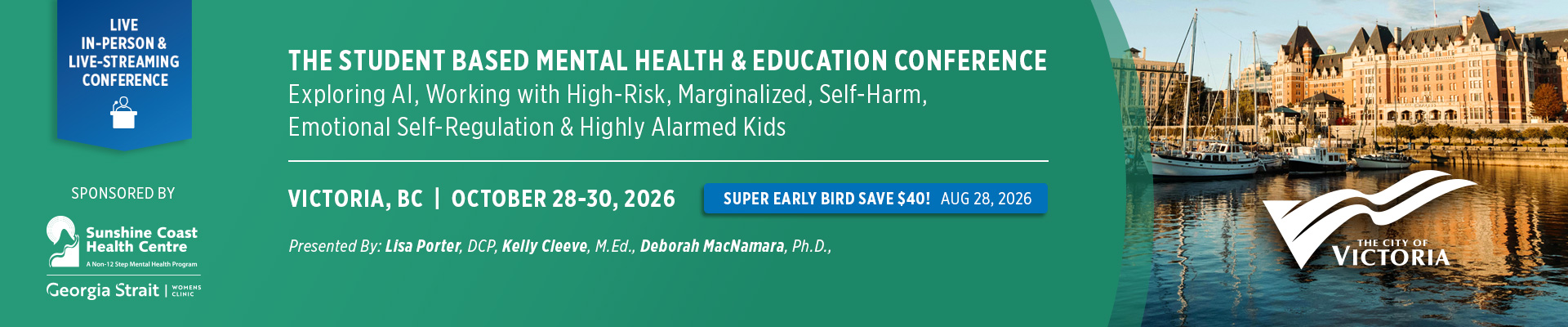
Presented by Lisa Porter, DCP, CCC, CCS and Kelly Cleeve, M.Ed., B.Ed., B.A and Deborah MacNamara, Ph.D.
Wednesday, October 28, 2026 – Friday, October 30, 2026 | Victoria, bc
Wednesday, October 28, 2026 – Friday, October 30, 2026
8:30am – 4:00pm
Sandman Inn Hotel Victoria
2852 Douglas Street., Victoria, BC
phone: 250.388.0788
website: www.sandmanhotels.com
Welcome to The Student Based Mental Health & Education Conference: Exploring AI, Working with High-Risk, Marginalized, Self-Harm, Emotional Self-Regulation & Highly Alarmed Kids in Victoria, BC.
On behalf of Jack Hirose & Associates, welcome and thank you for joining us in beautiful Victoria, British Columbia. We are delighted to bring together educators, counsellors, therapists, administrators, and helping professionals from across Canada for three days of practical, evidence-informed learning.
Our conference venue is conveniently located just minutes from Victoria’s picturesque Inner Harbour, marina, restaurants, shops, and many of the city’s most popular attractions. We encourage you to take advantage of your time here by exploring the waterfront, enjoying the local cuisine, and experiencing the unique charm and hospitality that Victoria has to offer.
Throughout the conference, you will explore practical strategies for supporting children and youth facing trauma, emotional dysregulation, mental health challenges, and the impacts of today’s digital world.
We hope you enjoy both the conference and your time in Victoria, and leave feeling inspired, connected, and equipped with new ideas to support the children and youth in your communities.
Education and Clinical Professionals: All education and mental health or healthcare professionals who work with children or youth including, but not limited to K–12 Classroom Teachers, School Counsellors, Learning Assistance/Resource Teachers, School Administrators, School Paraprofessionals including Special Education Assistants, Classroom Assistants and Childcare Workers • All other professionals who support behavioural challenges and complex learning needs including but not limited to: Nurses, Social Workers, Psychologists, Clinical Counsellors, Family Therapists, Occupational Therapists, Speech Language Pathologists, Addiction Counsellors, Youth Workers, Mental Health Workers, Probation Officers and Community Police Officers.
8:30am - 4:00pm October 28, 2026
WORKSHOP DESCRIPTION
Children, adolescents, and adults are navigating a world increasingly shaped by social media, smartphones, artificial intelligence, and constant digital connectivity. These technologies are influencing how people learn, communicate, form relationships, seek support, and experience mental health challenges. Educators and clinicians are often left wondering how to respond effectively while supporting wellbeing in a rapidly changing environment.
This practical workshop provides evidence-informed strategies for promoting digital wellness in schools, counselling settings, healthcare environments, and community programs. Participants will explore the relationship between technology use and mental health, including concerns related to anxiety, depression, social comparison, sleep disruption, attention difficulties, cyberbullying, FoMO, emotional regulation, and social connection.
Drawing on current research and real-world examples, the workshop will examine how artificial intelligence and digital technologies are changing learning, help-seeking behaviours, and interpersonal relationships. Participants will learn practical approaches for supporting healthy technology habits, strengthening resilience, fostering critical thinking, and helping young people navigate online spaces safely and responsibly.
The workshop will also address emerging issues such as AI companionship, academic integrity in the age of generative AI, and the ethical considerations surrounding the use of AI in educational and clinical settings. Rather than focusing solely on restricting technology use, participants will explore ways to work with these tools constructively while maintaining the human connection that remains central to learning, development, and therapeutic change.
Through case studies, discussion, and practical applications, attendees will leave with concrete strategies that can be implemented immediately to support mental health, digital wellbeing, and healthy engagement with technology across a variety of educational and clinical contexts.
AGENDA
LEARNING OBJECTIVES
By the end of this workshop, participants will be able to:
Lisa Porter, DCP, CCC, CCS, started her career as a high school teacher, working in the public education in both Alberta and BC. She later transitioned into high school counselling, where she spent ten years supporting student mental health and…
8:30am - 4:00pm October 29, 2026
WORKSHOP DESCRIPTION
Creating classrooms where every student feels seen, valued, and connected has never been more important. As Canadian classrooms become increasingly diverse, educators are challenged to support students with a wide range of cultural identities, lived experiences, learning needs, and social-emotional strengths. This engaging and interactive workshop explores how social-emotional learning (SEL) can move beyond teaching individual skills to become a powerful framework for fostering belonging, inclusion, and student empowerment.
Grounded in current research and practical classroom experience, participants will examine the connections between social-emotional learning, equity, and student well-being while exploring the barriers that can prevent marginalized and underserved learners from experiencing a true sense of belonging. Through reflective activities, case studies, collaborative discussions, and practical classroom strategies, attendees will discover how relationship-centred, culturally responsive, and trauma-informed approaches can create learning environments where every student is supported to thrive.
Participants will also explore Transformative Social-Emotional Learning (tSEL), critically examine traditional SEL frameworks through an equity lens, and develop practical strategies that honour diverse identities, experiences, and ways of learning. Throughout the day, educators will leave with evidence-informed tools they can immediately apply to strengthen relationships, increase student engagement, and build more inclusive classroom communities.
LEARNING OBJECTIVES

With more than twenty years of experience in Canadian education, Kelly Cleeve is a respected educator, facilitator, and lecturer dedicated to advancing social-emotional learning, inclusion, and student well-being. She has worked with teachers, school leaders, and educational organizations across British…
8:30am - 4:00pm October 30, 2026
WORKSHOP DESCRIPTION
Some children and youth seem impossible to reach. They resist help, reject relationship, avoid vulnerability, push adults away, or appear emotionally shut down altogether. Traditional behavioural approaches often fail to make headway because the issue is not simply behaviour — it is alarm, adaptation, defended attachment, and much more.
Many of our most vulnerable children have experienced too much separation, instability, stress, disconnection, or emotional pain. Others may have received care but struggle to trust, depend, or receive it. In these contexts, relationship itself can become defended against.
This presentation moves beyond surface-level behaviour management — and even beyond conventional trauma-informed approaches — to explore the developmental and relational roots of disconnection, alarm, and emotional defenses. Participants will gain insight into why some children resist closeness, why caring adults can feel shut out, and how alarm and attachment dynamics shape behaviour, learning, and emotional well-being.
Grounded in developmental science, attachment theory, and practical relational experience, this seminar will explore how educators, counsellors, youth workers, and helping professionals can make meaningful headway with hard-to-reach children and youth. Participants will learn how to reduce alarm, work with — rather than against — defenses, build trust and connection over time, and create the conditions where growth, learning, and emotional healing can unfold.
This highly practical workshop will integrate real-life examples, guided reflection, and case-based application to help participants translate developmental-relational understanding into meaningful action within their own settings and with the children and youth in their care.
LEARNING OBJECTIVES

Deborah MacNamara, PhD is a clinical counsellor and educator with more than 25 years’ experience working with children, youth, and adults. She is on faculty at the Neufeld Institute, operates a counselling practice, and speaks regularly about child and adolescent development…
More information: www.neufeldinstitute.org/person/deborah-macnamara/
| Registration | Super Early Bird Fee | Early Bird Fee | Regular Fee |
|---|---|---|---|
| ONE DAY ENROLLMENT | -- | ||
| Individual 1 Day Enrollment | $279.00 | $299.00 | $319.00 |
| 1 Day Group 3-7 | $229.00 | $249.00 | $269.00 |
| 1 Day Group 8-14 | $209.00 | $229.00 | $249.00 |
| 1 Day Group 15+ | $189.00 | $209.00 | $229.00 |
| 1 Day Full-Time Student | $189.00 | $209.00 | $229.00 |
| -- | |||
| TWO DAY ENROLLMENT | -- | ||
| Individual 2 Day Enrollment | $499.00 | $519.00 | $539.00 |
| 2 Day Group 3-7 | $459.00 | $469.00 | $489.00 |
| 2 Day Group 8-14 | $429.00 | $449.00 | $469.00 |
| 2 Day Group 15+ | $399.00 | $419.00 | $439.00 |
| 2 Day Full-Time Student | $399.00 | $419.00 | $439.00 |
| -- | |||
| THREE DAY ENROLLMENT | -- | ||
| Individual 3 Day Enrollment | $669.00 | $689.00 | $699.00 |
| 3 Day Group 3-7 | $619.00 | $639.00 | $659.00 |
| 3 Day Group 8-14 | $599.00 | $619.00 | $629.00 |
| 3 Day Group 15+ | $469.00 | $489.00 | $509.00 |
| 3 Day Full-Time Student | $469.00 | $489.00 | $509.00 |
All fees are per person and in Canadian Dollars ($CAD)
Fees do not include applicable taxes (5% GST).
Super early bird cutoff date: August 28, 2026
To receive the super early bird rate, registration and payment must be received by Friday, August 28, 2026.
Early bird cutoff date: September 28, 2026
To receive the early bird rate, registration and payment must be received by Monday, September 28, 2026.
Please review our Registration Terms and Conditions for information on our cancellation policy, payment policies, rebates, and more. You must agree to our Terms and Conditions to register for a workshop or conference.
All brochures and forms are provided in .PDF format.
If you are unable to open our files, we recommend downloading Adobe Reader for free.
2852 Douglas Street., Victoria, BC
phone: 250.388.0788
website: www.sandmanhotels.com
Our rates:
Please contact the hotel directly for the best available rates.
680 Montreal St, Victoria, BC V8V 1Z8
phone: 250.386.8721
website: www.laurelpoint.com/
Our rates:
Please contact the hotel directly for the best available rates.
Jack Hirose & Associates is approved by the Canadian Psychological Association to offer continuing education for psychologists. Jack Hirose & Associates maintains responsibility for the program.
† The Alberta College of Social Workers (ACSW) and the Newfoundland and Labrador Association of Social Workers (NLASW) accept CPA-approved CEUs.
* Participants will receive a certificate of completion after every workshop. Workshops are pre-approved for 5.5 or 6 credits per day unless otherwise specified.
Please check back closer to the conference date for more information.
There are no related events at this time.
