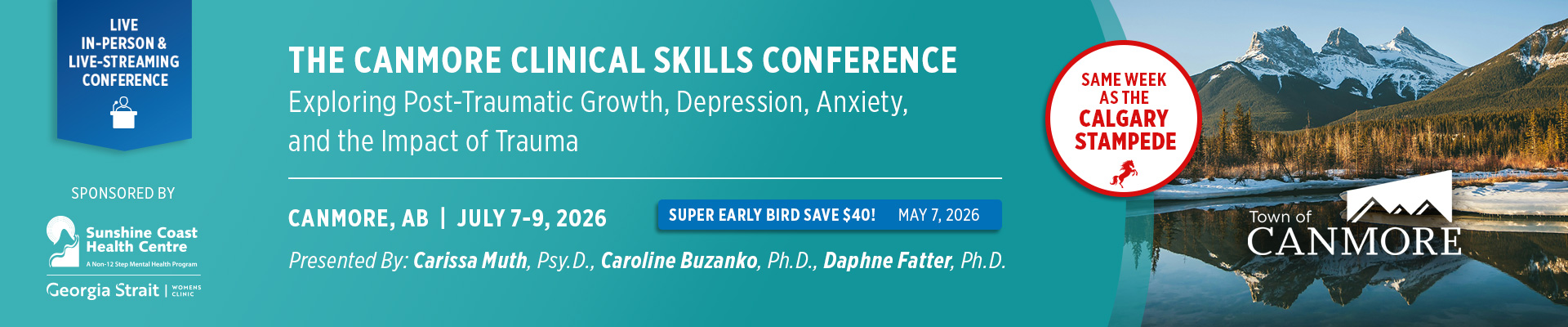
The Canmore Clinical Skills Conference: Exploring Post-Traumatic Growth, Depression, Anxiety, and the Impact of Trauma
Presented by
Carissa Muth, Psy.D., CCC, R.Psych
and Caroline Buzanko, Ph.D., R. Psych
and Daphne Fatter, Ph.D.
Tuesday, July 7, 2026 – Thursday, July 9, 2026
|
Canmore, ab
Date & Location
Tuesday, July 7, 2026 – Thursday, July 9, 2026
8:30am – 4:00pm
Canmore Nordic Centre
1988 Olympic Way, Canmore, AB


Who Should Attend
Clinical Professionals: All mental health professionals including, but not limited to Clinical Counsellors, Psychologists, Psychotherapists, Social Workers, Nurses, Occupational Therapists, Hospice and Palliative Care Workers, School Counsellors, Youth Workers, Mental Health Workers, Addiction Specialists, Marital & Family Therapists, Speech Language Pathologists, Vocational Rehabilitation Consultants and all professionals looking to enhance their therapeutic skills.
Day One – July 7, 2026
Post-Traumatic Growth: Healing Emotional & Psychological Trauma
Presented by
Carissa Muth, Psy.D., CCC, R.Psych
8:30am - 11:45am July 7, 2026
COURSE DESCRIPTION
In this transformative workshop, Dr. Carissa Muth challenges the traditional clinical focus on symptom reduction, inviting psychotherapists to explore the potential for profound positive change following adversity. “Post-Traumatic Growth” (PTG) is not about returning to baseline; it is about the paradoxical experience of gaining strength, wisdom, and purpose through the struggle with trauma. Dr. Muth guides participants through the theoretical and practical applications of PTG, moving beyond the medical model of “disorder” to a humanistic model of “transformation.” The session distinguishes clearly between resilience (bouncing back) and growth (bouncing forward), providing clinicians with the tools to identify the five domains of PTG in their clients. Through narrative reconstruction and existential inquiry, therapists will learn how to facilitate the “rumination to reflection” shift, helping clients mine their painful experiences for new meaning. This workshop equips providers to hold space for suffering while simultaneously illuminating the path toward a richer, more authentic life.
Show more
LEARNING OBJECTIVES
- Differentiate between Resilience, Recovery, and Post-Traumatic Growth to set appropriate clinical expectations and identify when a client is ready for growth-focused work.
- Assess the five core domains of Post-Traumatic Growth (Personal Strength, New Possibilities, Relating to Others, Appreciation of Life, and Spiritual Change) using evidence-based inquiries.
- Facilitate the cognitive shift from “Intrusive Rumination” (unwanted, repetitive thoughts) to “Deliberate Rumination” (intentional processing/meaning-making).
- Apply narrative interventions that help clients “re-story” their trauma, moving the narrative arc from one of victimization/loss to one of survival/heroism.
- Implement “Expert Companionship” strategies, learning how to listen for and amplify subtle markers of growth without minimizing the client’s pain or bypassing their grief.
COURSE OUTLINE
Module 1: Beyond the Diagnosis – Defining PTG
- The Shattered Vase Metaphor: Why we can’t just “glue it back together” (recovery) but must create a mosaic (growth).
- The Paradox of PTG: Understanding that growth and distress often coexist; one does not cancel out the other.
- The Neurobiology of Change: How the disruption of core schemas forces the brain to accommodate new, more complex understandings of the world.
Module 2: The Five Domains of Growth
- Personal Strength: “I survived the worst, so I can handle anything.”
- New Possibilities: Identifying doors that opened only because others closed.
- Relating to Others: The deepening of empathy and connection through shared suffering.
- Appreciation of Life: The shift from “taking things for granted” to mindful gratitude.
- Spiritual/Existential Change: Grappling with big questions and finding deeper purpose.
Module 3: From Rumination to Reflection
- The Engine of PTG: Why we need to think about the trauma to grow from it.
- Intrusive vs. Deliberate: Teaching clients to grab the wheel of their thinking.
- Clinical Tool: Structured writing exercises to move from “Why me?” (victim) to “What now?” (survivor).
Module 4: Narrative Reconstruction
- The “Before” and “After” Self: Integrating the split caused by trauma.
- Double Listening: Training therapists to hear the story of suffering and the story of resistance simultaneously.
- Legacy Work: Helping clients decide how this chapter fits into the whole book of their life.
Module 5: The Therapist as “Expert Companion”
- Avoiding Toxic Positivity: The danger of pushing for growth too soon.
- Timing the Intervention: Recognizing the “readiness cues” for meaning-making work.
- Vicarious Growth: How witnessing a client’s transformation can positively impact the therapist’s own worldview.
Module 6: Closing & Application

Dr. Carissa Muth is a registered psychologist in Alberta and the Clinical Director at the Sunshine Coast Health Centre and Georgia Strait Women’s Clinic. She holds Doctorate of Psychology, Master of Arts in Counselling, and Bachelor of Social Work degrees…
→ Read more
The Clinical Power Couple: Integrating CBT and DBT Strategies for Trauma, Addictions, Anxiety, Depression, OCD, and Chronic Pain
Presented by
Carissa Muth, Psy.D., CCC, R.Psych
12:45pm - 4:00pm July 7, 2026
COURSE DESCRIPTION
In this high-impact training, Dr. Carissa Muth demonstrates how to merge the two most established modalities in mental health—Cognitive Behavioural Therapy (CBT) and Dialectical Behaviour Therapy (DBT)—into a unified, transdiagnostic toolkit. While CBT offers powerful strategies for cognitive change and exposure, it often fails with clients who lack the emotional regulation skills to tolerate the work. Conversely, DBT provides excellent stabilization but may not sufficiently address the core schemas driving chronic disorders. This workshop bridges that gap. Dr. Muth will guide participants through a “Stabilize-Then-Process” framework, showing how to use DBT skills to widen the window of tolerance in clients with complex trauma, addiction, and chronic pain, before applying CBT interventions to restructure maladaptive beliefs and behaviours. Participants will learn to move fluidly between the “Change” focus of CBT and the “Acceptance” focus of DBT, specifically addressing the overlapping mechanisms of avoidance and dysregulation found in OCD, depression, and anxiety.
COURSE OUTLINE
Module 1: The Dialectical Framework – Acceptance vs. Change
- The Integration Model: Why CBT needs DBT (for regulation) and DBT needs CBT (for restructuring).
- Transdiagnostic Drivers: Identifying the shared roots of these disorders: Intolerance of Uncertainty, Emotional Avoidance, and Cognitive Rigidity.
- The Sequencing Rule: Assessing “Skill Deficits” vs. “Performance Deficits” to decide where to start.
Module 2: Stabilization & Safety (Trauma & Addiction)
- DBT Distress Tolerance: Using T.I.P. skills (Temperature, Intense exercise, Paced breathing) to manage the “hijacked brain” in PTSD and addiction crises.
- Urge Surfing: Teaching clients to ride the wave of craving without acting on it.
- CBT Relapse Prevention: Identifying “high-risk situations” and cognitive “permission-giving thoughts” (e.g., “Just one won’t hurt”).
Module 3: The Anxiety & OCD Spectrum – Facing the Fear
- The “Check the Facts” Skill (DBT): Reducing emotional intensity before engaging in logic.
- Exposure & Response Prevention (CBT): The gold standard for OCD.
- Merging the Two: Using DBT Mindfulness (“Teathers”) to stay present during high-intensity CBT exposures without dissociating.
Module 4: Depression – Moving from Inertia to Action
- Behavioral Activation (CBT): Scheduling mastery and pleasure to jumpstart the reward system.
- Opposite Action (DBT): Acting opposite to the emotion urge (e.g., “My depression wants to isolate, so I will go to the coffee shop”).
- Cognitive Restructuring: Identifying the “Negative Triad” (Self/World/Future) and Socratic questioning.
Module 5: Chronic Pain – A Special Application
- Pain vs. Suffering: The equation Suffering = Pain x Resistance.
- Radical Acceptance (DBT): Accepting the reality of the diagnosis to stop the exhausting fight against it.
- Pacing (CBT): Breaking the “Boom and Bust” cycle of activity common in chronic pain patients.
- Fear-Avoidance Model: Using exposure to reduce the fear of movement (kinesiophobia).
Module 6: Complex Case Synthesis
- Treatment Mapping: Participants practice designing a roadmap that weaves these tools together without overwhelming the client.
- Q&A
Show more
LEARNING OBJECTIVES
- Construct a sequenced treatment plan that prioritizes DBT Distress Tolerance skills for physiological stabilization before initiating CBT-based trauma processing or exposure work.
- Apply the DBT skill of Radical Acceptance specifically to Chronic Pain and Trauma populations to reduce “secondary suffering” (the resistance to pain).
- Differentiate between the cognitive interventions of CBT (challenging the validity of thoughts) and DBT (mindfully observing thoughts without judgment), and determine which approach to use for Obsessive-Compulsive cycles.
- Implement “Urge Surfing” (DBT) and “Behavioral Experiments” (CBT) in tandem to treat Substance Use Disorders, targeting both the physiological craving and the permission-giving beliefs.
- Utilize Behavioral Activation (CBT) and Opposite Action (DBT) to break the lethargy-avoidance cycle in severe Depression and Anxiety.
Day Two – July 8, 2026
Conquering Anxiety: Concrete Clinical Strategies for Treating Anxiety and Depression
Presented by
Caroline Buzanko, Ph.D., R. Psych
8:30am - 4:00pm July 8, 2026
COURSE DESCRIPTION
Think you’ve mastered everything you need to know about anxiety management? Think again – you might be surprised!
When it comes to treating anxiety, even the most experienced professionals can unknowingly perpetuate ineffective methods. For instance, are you relying on reducing anxious feelings to gauge the success of your interventions? Do you use fear hierarchies? Do you advocate deep breathing or relaxation techniques as anxiety-busting strategies? If so, you may be unknowingly contributing to your clients’ cycle of anxiety.
If you’re committed to elevating your understanding of emotional health and improving outcomes for anxious clients, this workshop is indispensable. It is essential to revolutionize your approach to anxiety and emotional well-being. Go beyond the surface to explore the intricacies of anxiety and emotion regulation. Seamlessly blending the latest research with practical techniques, this workshop equips you with actionable insights that can be applied to real-world cases immediately.
Why Attend?
- Unlock a robust toolbox of effective interventions backed by cutting-edge research.
- Gain a deep, nuanced understanding of anxiety, going beyond traditional methods that may inadvertently perpetuate anxiety.
- Every principle is illuminated with real-life case studies, ensuring the knowledge you acquire is directly applied in your practice.
- Walk away with a fresh perspective about anxiety and an arsenal of strategies that actually make a difference.
Show more
LEARNING OBJECTIVES
-
Critically examine common anxiety-management practices (e.g., symptom reduction, fear hierarchies, relaxation techniques) and identify how they may unintentionally maintain anxiety.
-
Explain anxiety and emotion regulation using contemporary, research-informed frameworks that move beyond traditional coping-based approaches.
-
Differentiate effective vs. ineffective interventions for anxiety based on current empirical evidence.
-
Apply evidence-based strategies that target the underlying mechanisms of anxiety rather than short-term symptom relief.
-
Integrate real-world case examples to inform clinical decision-making and improve outcomes for anxious clients.
-
Implement practical, immediately usable tools to support lasting emotional regulation and resilience in clinical or educational settings.

Caroline Buzanko, Ph.D., R. Psych, is a psychologist. Mother. Professor. International Speaker. Yoda of Anxiety. ADHD Superhero. And Changer of Lives. With nearly three decades of experience, she is a recognized expert in resilience and the social, emotional, and behavioural well-being…
→ Read more
Day Three – July 9, 2026
Practices for Healing Intergenerational Trauma
Presented by
Daphne Fatter, Ph.D.
8:30am - 4:00pm July 9, 2026
COURSE DESCRIPTION
Every human being carries the psychological, emotional and biological imprint of ancestors that came before them. In this six-hour workshop, clinicians will learn how to assess and identify clinical indicators of both historical and intergenerational trauma. Current research on the transmission of trauma across generations due to historical trauma, the impact of colonization, and intergenerational trauma will be reviewed. Participants will learn trauma assessment measures for historical trauma and on-going racial trauma. Participants will be introduced to practical, accessible methods for providing psychoeducation on intergenerational trauma and integrating cultural strength-based resources into clinical practice.
Dr. Fatter will present evidenced-based approaches for working with intergenerational trauma in individual therapy, including using Narrative Exposure Therapy, Eye Movement Desensitization Reprocessing (EMDR), and cognitive-behavioral therapy for racial trauma. Participants will learn how to apply an intergenerational lens to case conceptualization, and how each modality approaches working with intergenerational trauma. Emerging practices such as parts work, ancestral lineage healing, and family constellation methods will also be explored. Group therapy interventions and multi-family therapy models will also be discussed. This workshop will combine didactic learning with experiential exercises.
COURSE OUTLINE
- Definitions of historical, intergenerational, and collective trauma
- Research review on transmission of intergenerational and historical trauma
- Clinical indicators of intergenerational and historical trauma
- Ethical considerations, cultural humility, decolonization principles, liberation psychology, and applying an anti-oppressive lens
- Review of assessment measures
- Introduction to generational trauma card for psychoeducation
- Practical strength-based methods to integrate cultural resources in clinical work
- Application of evidence-based trauma modalities to intergenerational trauma
- Develop an intergenerational lens on case conceptualization
- Practice ways to create energetic boundaries to cope with vicarious trauma exposure
- Experientially practice preparation steps for ancestral lineage healing
Show more
LEARNING OBJECTIVES
- Demonstrate at least one way to integrate cultural strength-based resources in clinical work with clients.
- Identify clinical signs of historical trauma.
- Demonstrate at least one attachment-based strategy for explaining intergenerational trauma to clients.
- Describe key findings from research on intergenerational trauma.
- Apply an intergenerational lens to case conceptualization in individual or family therapy.
- Describe at least one evidence-based trauma modality and how it can be used for intergenerational trauma.

Daphne Fatter, Ph.D. is a licensed psychologist, international speaker and consultant in private practice in Dallas, Texas. Having trained under the direct supervision of Dr. Bessel van der Kolk, MD., international pioneer in research on traumatic stress, Dr. Fatter is…
→ Read more
Registration & Fees
| Registration |
Super Early Bird Fee |
Early Bird Fee |
Regular Fee |
| ONE DAY ENROLLMENT |
--
|
|
|
| Individual 1 Day Enrollment |
$279.00 |
$299.00 |
$319.00 |
| 1 Day Group 3-7 |
$229.00 |
$249.00 |
$269.00 |
| 1 Day Group 8-14 |
$209.00 |
$229.00 |
$249.00 |
| 1 Day Group 15+ |
$189.00 |
$209.00 |
$229.00 |
| 1 Day Full-Time Student |
$189.00 |
$209.00 |
$229.00 |
|
--
|
|
|
| TWO DAY ENROLLMENT |
--
|
|
|
| Individual 2 Day Enrollment |
$499.00 |
$519.00 |
$539.00 |
| 2 Day Group 3-7 |
$459.00 |
$469.00 |
$489.00 |
| 2 Day Group 8-14 |
$429.00 |
$449.00 |
$469.00 |
| 2 Day Group 15+ |
$399.00 |
$419.00 |
$439.00 |
| 2 Day Full-Time Student |
$399.00 |
$419.00 |
$439.00 |
|
--
|
|
|
| THREE DAY ENROLLMENT |
--
|
|
|
| Individual 3 Day Enrollment |
$669.00 |
$689.00 |
$699.00 |
| 3 Day Group 3-7 |
$619.00 |
$639.00 |
$659.00 |
| 3 Day Group 8-14 |
$599.00 |
$619.00 |
$629.00 |
| 3 Day Group 15+ |
$469.00 |
$489.00 |
$509.00 |
| 3 Day Full-Time Student |
$469.00 |
$489.00 |
$509.00 |
All fees are per person and in Canadian Dollars ($CAD)
Fees do not include applicable taxes (5% GST).
Super early bird cutoff date: May 7, 2026
To receive the super early bird rate, registration and payment must be received by Thursday, May 7, 2026.
Early bird cutoff date: June 7, 2026
To receive the early bird rate, registration and payment must be received by Sunday, June 7, 2026.
Register Online Register your Group
Downloads
All brochures and forms are provided in .PDF format.
If you are unable to open our files, we recommend downloading Adobe Reader for free.
Exhibitors are welcome at this event. We are pleased to offer sponsorship opportunities to businesses and organizations that provide services related to nursing, psychotherapy, addictions treatment, counselling, marriage & family therapy, psychology and other related fields.
→ More information
Recommended Accommodation
Coast Canmore Hotel & Conference Centre
511 Bow Valley Trail, Canmore, AB T1W 1N7
 Full map & directions
Our rates:
Please contact the hotel directly for the best available rates.
Continuing Education Credits
Please check back closer to the conference date for more information.
Related Events
There are no related events at this time.