Home >
Upcoming Workshops >
Child & Youth Focus > The Saskatoon Child and Adolescent Conference on Behavioural Challenges, At-Risk Children and Youth, Indigenous Approaches, Strength-Based Care, Resilience, and Self-Harm Response
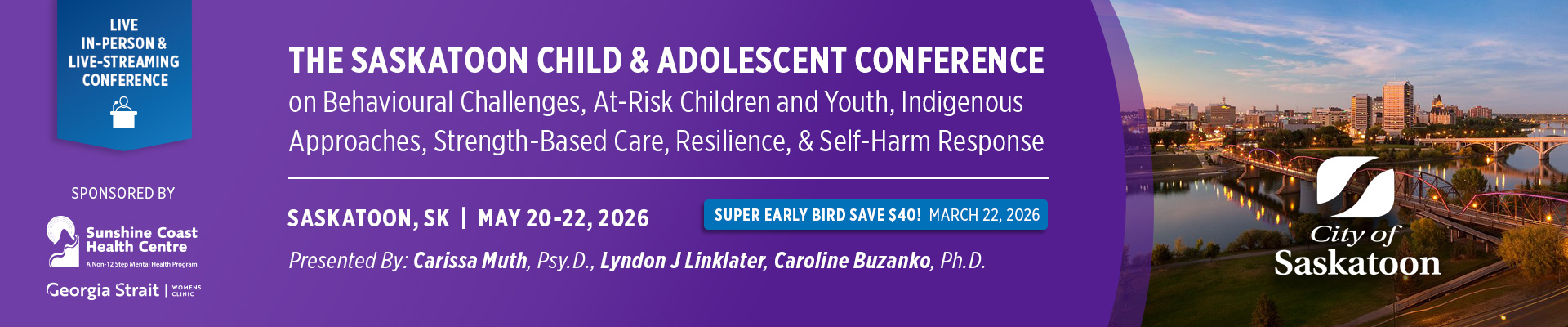
The Saskatoon Child and Adolescent Conference on Behavioural Challenges, At-Risk Children and Youth, Indigenous Approaches, Strength-Based Care, Resilience, and Self-Harm Response
Presented by
Carissa Muth, Psy.D., CCC, R.Psych
and Lyndon J. Linklater, BISW
and Caroline Buzanko, Ph.D., R. Psych
Wednesday, May 20, 2026 – Friday, May 22, 2026
|
Saskatoon, sk
Date & Location
Wednesday, May 20, 2026 – Friday, May 22, 2026
8:30am – 4:00pm
Park Town Hotel
924 Spadina Crescent E
Saskatoon, SK S7K 3H5


Who Should Attend
Education and Clinical Professionals: K–12 Classroom Teachers, School Counsellors/Psychologists, Learning Assistance/ Resource Teachers, School Administrators, School Paraprofessionals including Special Education Assistants, Classroom Assistants and Childcare Workers. All other professionals who support students including but not limited to: Nurses, Social Workers, Psychologists, Clinical Counsellors, Family Therapists, Occupational Therapists, Speech Language Pathologists, Addiction Counsellors, Youth Workers, Mental Health Workers, Probation Officers, and Early Childhood Educators.
Day One – May 20, 2026
Working with High Risk Children and Adolescents: Collaborative and Strength-Based Interventions
Presented by
Carissa Muth, Psy.D., CCC, R.Psych
8:30am - 4:00pm May 20, 2026
COURSE DESCRIPTION
This workshop provides participant with advanced frameworks for effectively treating children and adolescents who present with high-risk behaviours and complex emotional dysregulation. Moving beyond traditional compliance-based models, the training emphasizes collaborative, strength-based interventions that empower young clients and enlist families as active partners in the healing process. Participants will explore the neurobiology of “challenging” behaviour, reframing explosive outbursts and opposition as adaptive responses to unmet needs or skill deficits.
The session offers a deep dive into practical risk assessment and safety planning, ensuring youth and child professionals can manage acute crises such as self-harm, aggression, and suicidality with confidence. Dr. Muth will demonstrate how to integrate evidence-based approaches—including Collaborative & Proactive Solutions (CPS), Motivational Interviewing, and Solution-Focused Brief Therapy—to resolve chronic problems and reduce therapeutic resistance. Finally, the workshop equips attendees with tools to build cross-sector teams, bridging the gap between therapy, school, and home environments to create a unified safety net for at-risk youth.
WORKSHOP OUTLINE
Module 1: Paradigm Shift – Understanding the “Why”
- The Myth of Motivation: Dr. Muth debunks the idea that “kids do well if they want to” and explores the philosophy of “kids do well if they can.”
- The Neurobiology of “Bad” Behavior:
- The role of the amygdala and prefrontal cortex in dysregulation.
- Fight/Flight/Freeze responses in clinical settings.
- Strength-Based Profiling: Moving beyond diagnostic labels to map the child’s assets, resilience factors, and “islands of competence.”
Module 2: Risk Assessment & Crisis Management
- Triage and Assessment:
- Differentiating between suicidal ideation, non-suicidal self-injury (NSSI), and aggression/conduct issues.
- Assessing lethality, intent, and access to means.
- Safety Planning 2.0: Moving beyond the “contract for safety.” Creating dynamic plans that include specific coping skills, identified support people, and environmental restrictions.
- Legal & Ethical Considerations: When to breach confidentiality, duty to report, and navigating consent with minors.
Module 3: The Collaborative Toolkit – Integrated Interventions
- Collaborative & Proactive Solutions (CPS):
- Dr. Muth reviews the “Plan B” conversation structure to solve problems collaboratively rather than unilaterally.
- Motivational Interviewing (MI) for Adolescents:
- “Rolling with Resistance”: How to sidestep power struggles when a client is defensive.
- Using “Change Talk” to increase intrinsic motivation for safety.
- Solution-Focused Techniques:
- The Miracle Question and Exception Finding: Identifying times when the problem isn’t happening to build on success.
- Narrative Approaches:
- Externalizing the problem (e.g., “fighting The Rage” vs. “being an angry kid”) to reduce shame and defensiveness.
Module 4: Engaging the System – Families and Schools
- Parent Coaching with PACE:
- Using Dr. Dan Hughes’ Playfulness, Acceptance, Curiosity, and Empathy (PACE) model to help parents co-regulate rather than police behavior.
- Addressing Caregiver Burnout: Validating the exhaustion of raising a high-needs child while teaching parents to manage their own triggers.
Module 5: Advanced Case Application & Synthesis
- Complex Case Studies: Reviewing real-world scenarios presented by Dr. Muth involving dual diagnoses (e.g., ASD + Trauma, ADHD + ODD).
- Selecting the Right Tool: Discussing when to use CPS vs. MI vs. rigid safety protocols based on the client’s current state of regulation.
- Troubleshooting: “What if the child refuses to talk?” Strategies for non-verbal engagement and building safety without words.
Module 6: Closing & Sustainability
- Review of Key Concepts: Rapid recap of the integrated toolkit.
- Self-Care for the Therapist: Managing countertransference and vicarious trauma when working with aggression and high-stakes risk.
- Q&A
Show more
LEARNING OBJECTIVES
- Reframe high-risk and oppositional behaviours through a neurodevelopmental and trauma-informed lens, shifting the clinical focus from “willful disobedience” to “lagging skills” and nervous system dysregulation.
- Conduct a comprehensive risk assessment that distinguishes between acute safety threats (imminent harm) and chronic maladaptive patterns, utilizing specific protocols for suicide and violence risk.
- Apply specific techniques from Motivational Interviewing (MI) and Solution-Focused Therapy (SFBT) to navigate resistance, externalize problems, and identify existing resilience in reluctant clients.
- Utilize the core principles of Collaborative & Proactive Solutions (CPS) to facilitate problem-solving conversations that increase client buy-in and reduce power struggles.
- Develop robust, collaborative safety plans that integrate the child’s strengths and the family’s resources, ensuring interventions are actionable during moments of crisis.

Dr. Carissa Muth is a registered psychologist in Alberta and the Clinical Director at the Sunshine Coast Health Centre and Georgia Strait Women’s Clinic. She holds Doctorate of Psychology, Master of Arts in Counselling, and Bachelor of Social Work degrees…
→ Read more
Day Two – May 21, 2026
Applying Indigenous Practices to Build Resilience and Strength in Children and Adolescents
Presented by
Lyndon J. Linklater, BISW
8:30am - 4:00pm May 21, 2026
COURSE DESCRIPTION
In this transformative full-day workshop, Lyndon Linklater draws on Indigenous worldviews, cultural teachings, and over two decades of experience to illuminate how resilience is nurtured through identity, land, language, and community. Lyndon will guide participants in exploring the historical and contemporary significance of Treaties. This perspective will help attendees deepen their awareness of shared responsibilities and how Treaties influence educational, clinical, and community-based work today.
Participants will explore how children and adolescents carry not only inherited trauma, but also deep inherited strength—rooted in cultural continuity, kinship, and ancestral teachings. Through powerful storytelling, reflection, and practical guidance, Lyndon will support educators, clinicians, and community professionals in fostering environments where Indigenous young people feel valued, grounded, and connected.
ACTIVITIES
- Storytelling that highlights intergenerational strength and community leadership.
- Sharing of cultural teachings and examples of youth leadership.
- Group reflection: how to strengthen protective factors in practice.
- Treaty exercise
- Developing strategies to create spaces that celebrate identity, not just address hardship.
Show more
LEARNING OBJECTIVES
- Understand resilience from an Indigenous perspective.
- Identify key cultural protective factors that strengthen mental wellness and belonging.
- Apply Indigenous-informed approaches to support identity, connection, and healing in youth.

Lyndon J. Linklater, BISW is a traditional knowledge keeper and powerful storyteller with an educational background in Indian Social Work, Indian Studies, and law. He is a citizen of Thunderchild First Nation (Plains Cree) in Treaty 6 and has roots…
→ Read more
Day Three – May 22, 2026
Working with Children and Youth Who are High-Risk, Marginalized and Engage in Self-Harming
Presented by
Caroline Buzanko, Ph.D., R. Psych
8:30am - 4:00pm May 22, 2026
COURSE DESCRIPTION
For anyone who know that “safety contracts” don’t work and want to know what does. Self-harm among youth isn’t rising because young people are more fragile. It’s rising because the conditions they’re navigating create psychological states where harming one’s own body makes functional sense. This intensive 6-hour workshop is designed for anyone who work with the youth carrying the heaviest burdens: those at the intersection of marginalization, trauma, and self-injury.
You’ll move beyond risk management checklists to understand the why beneath the behaviour. Drawing on the established theories and evidence-based interventions for self-harm, this training provides the clinical precision needed when the stakes are highest.
This workshop addresses the reality that therapy fails when it replicates the same power dynamics that harm youth in the first place. You’ll learn how to structure engagement that honours adolescent autonomy, conduct chain analyses that reveal intervention points invisible in standard assessments, and teach physiological regulation skills that work when cognitive strategies fail. We’ll tackle the specific dialectical dilemmas of adolescent treatment: how to involve parents without breaking confidentiality, how to validate pain without reinforcing dysfunction, and how to adapt evidence-based protocols for youth who experience standard therapeutic language as minimizing and unhelpful.
You’ll also confront the parts of this work that textbooks skip: how to stay regulated when a 14-year-old shows you fresh burns, how to respond when a family’s exhaustion manifests as rage, and how to maintain therapeutic boundaries while practicing the “moral courage” required to witness historical trauma.
This workshop is key to develop enough technical skill and relational capacity that young people choose to stay alive long enough to discover they want to.
WORKSHOP OUTLINE
Module 1: Understanding Self-Harm Through Intersectional and Biosocial Frameworks
- Personal mapping
- The crisis in context
- Biosocial theory
- Ecology of marginalization
- Developmental versus pathological
- Under-regulation versus over-regulation
Module 2: Engagement, Assessment, and Building Alliance Across Difference
- Why youth hide
- Trauma-informed engagement
- Beyond tick-box assessment
- Structural engagement for autonomy
- Cultural safety strategies
- Fidelity versus flexibility
Module 3: Core Clinical Skills—The Technical Architecture of Intervention
- The “Power Tools” of DBT-A
- Crisis survival skills
- Dialectical thinking & function question
Module 4: Safety Planning, Family Systems, and Ethical Harm Reduction
- Collaborative safety planning
- Harm reduction strategies
- Family systems and the middle path
- Systemic context
Closing: Develop an implementation plan for one current high-risk client
Show more
LEARNING OBJECTIONS
- Analyze intersectional risk through biosocial and structural lenses
- Differentiate self-harm typology and match intervention to regulation profile
- Deploy crisis-specific physiological regulation skills
- Conduct behavioural chain analysis to identify micro-intervention points
- Navigate adolescent-family dialectical dilemmas
- Implement culturally responsive adaptations without compromising fidelity

Caroline Buzanko, Ph.D., R. Psych, is a psychologist. Mother. Professor. International Speaker. Yoda of Anxiety. ADHD Superhero. And Changer of Lives. With nearly three decades of experience, she is a recognized expert in resilience and the social, emotional, and behavioural well-being…
→ Read more
Registration & Fees
| Registration |
Super Early Bird Fee |
Early Bird Fee |
Regular Fee |
| ONE DAY ENROLLMENT |
--
|
|
|
| Individual 1 Day Enrollment |
$279.00 |
$299.00 |
$319.00 |
| 1 Day Group 3-7 |
$229.00 |
$249.00 |
$269.00 |
| 1 Day Group 8-14 |
$209.00 |
$229.00 |
$249.00 |
| 1 Day Group 15+ |
$189.00 |
$209.00 |
$229.00 |
| 1 Day Full-Time Student |
$189.00 |
$209.00 |
$229.00 |
|
--
|
|
|
| TWO DAY ENROLLMENT |
--
|
|
|
| Individual 2 Day Enrollment |
$499.00 |
$519.00 |
$539.00 |
| 2 Day Group 3-7 |
$459.00 |
$469.00 |
$489.00 |
| 2 Day Group 8-14 |
$429.00 |
$449.00 |
$469.00 |
| 2 Day Group 15+ |
$399.00 |
$419.00 |
$439.00 |
| 2 Day Full-Time Student |
$399.00 |
$419.00 |
$439.00 |
|
--
|
|
|
| THREE DAY ENROLLMENT |
--
|
|
|
| Individual 3 Day Enrollment |
$669.00 |
$689.00 |
$699.00 |
| 3 Day Group 3-7 |
$619.00 |
$639.00 |
$659.00 |
| 3 Day Group 8-14 |
$599.00 |
$619.00 |
$629.00 |
| 3 Day Group 15+ |
$469.00 |
$489.00 |
$509.00 |
| 3 Day Full-Time Student |
$469.00 |
$489.00 |
$509.00 |
All fees are per person and in Canadian Dollars ($CAD)
Fees do not include applicable taxes (5% GST).
Super early bird cutoff date: March 22, 2026
The super early bird date has passed. Early bird or regular rates apply.
Early bird cutoff date: April 22, 2026
To receive the early bird rate, registration and payment must be received by Wednesday, April 22, 2026.
Register Online Register your Group
Downloads
All brochures and forms are provided in .PDF format.
If you are unable to open our files, we recommend downloading Adobe Reader for free.
Exhibitors are welcome at this event. We are pleased to offer sponsorship opportunities to businesses and organizations that provide services related to nursing, psychotherapy, addictions treatment, counselling, marriage & family therapy, psychology and other related fields.
→ More information
Recommended Accommodation
Park Town Hotel
924 Spadina Crescent E
Saskatoon, SK S7K 3H5
 Full map & directions
Our rates:
Please use the following when booking a room:
Group Name: Jack Hirose Workshop. When booking online use group attendee code 2605JACKHI
King City View Room , $179 Plus taxes
Two Queen River View Room $189 plus taxes
Executive King River View Room $199 Plus taxes
Executive Two Queen River View Room $199 Plus taxes
*Plus tax and fees
Continuing Education Credits
Please check back closer to the conference date for more information.
Related Events
There are no related events at this time.