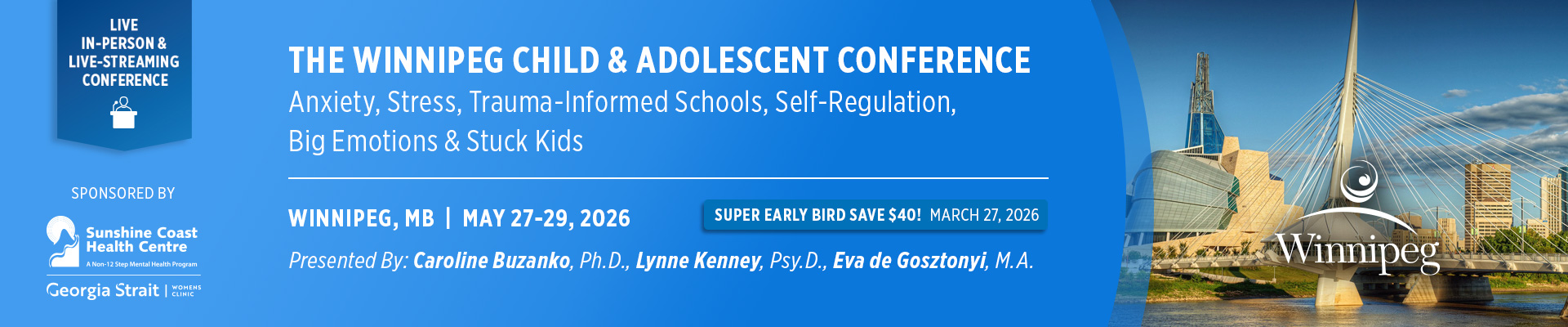
The Winnipeg Child & Adolescent Conference: Anxiety, Stress, Trauma-Informed Schools, Self-Regulation, Big Emotions and Stuck Kids
Presented by
Caroline Buzanko, Ph.D., R. Psych
and Lynne Kenney, Psy.D.
and Eva de Gosztonyi, M.A.
and Lyndon J. Linklater, BISW
Wednesday, May 27, 2026 – Friday, May 29, 2026
|
Winnipeg, mb
Date & Location
Wednesday, May 27, 2026 – Friday, May 29, 2026
8:30am – 4:00pm
Wyndham Garden Winnipeg Airport
460 Madison St, Winnipeg, MB R3J 1J1


Who Should Attend
Education and Clinical Professionals: K–12 Classroom Teachers, School Counsellors/Psychologists, Learning Assistance/ Resource Teachers, School Administrators, School Paraprofessionals including Special Education Assistants, Classroom Assistants and Childcare Workers. All other professionals who support students including but not limited to: Nurses, Social Workers, Psychologists, Clinical Counsellors, Family Therapists, Occupational Therapists, Speech Language Pathologists, Addiction Counsellors, Youth Workers, Mental Health Workers, Probation Officers, and Early Childhood Educators.
Day One – May 27, 2026
Optimizing Self-Regulation and Managing Big Emotions with Children & Adolescents
Presented by
Caroline Buzanko, Ph.D., R. Psych
8:30am - 4:00pm May 27, 2026
COURSE DESCRIPTION
In today’s world, our children and youth face an unprecedented level of stress and pressure, making it hard to effectively self-regulate and manage day-to-day stressors. As parents, educators, and mental health professionals, it’s essential that we equip ourselves with effective strategies to help children and teens develop the skills they need to navigate life’s challenges. When they don’t know how to manage those emotions, problem behaviours often result and can negatively affect their physical, psychological, academic, and social well-being. For many, they struggle to meet even the most basic expectations. It is essential they receive the right support.
Join us for a transformative workshop designed for mental health professionals, educators, parents, and caregivers to build self-regulation and emotional management skills in children and teens. During this workshop, you’ll learn evidence-based interventions and practical tools to promote healthy self-regulation and emotional management skills in children and youth. This workshop will provide you with the knowledge and skills you need to make a meaningful difference in the lives of the children and teens you work with. Join us in this engaging and practical workshop, where you will leave with the skills and knowledge to empower children and youth to manage their emotions, overcome challenges, and build resilience.
Show more
LEARNING OBJECTIVES
- Understanding self-regulation
- The emotional brain and its power over executive functioning
- The role of emotions, their functions, and behavioural outcomes
- Misbehaviour vs. stressed behaviour
- The influence of adult expectations and responses on development, effective co-regulation, and nurturing words that regulate
- Fundamental skills for effective emotion regulation, including interoceptive awareness, emotional literacy working memory, flexibility, tolerance, behavioural inhibition, meta-thinking, and decision-making
- Strategies for recognizing and managing big emotions
- Exposure and practice
- Evidence-based interventions for promoting self-regulation
- Strategies for supporting parents and caregivers in reinforcing emotional regulation skills
- Promoting long-term independence and resilience

Caroline Buzanko, Ph.D., R. Psych, is a psychologist. Mother. Professor. International Speaker. Yoda of Anxiety. ADHD Superhero. And Changer of Lives. With nearly three decades of experience, she is a recognized expert in resilience and the social, emotional, and behavioural well-being…
→ Read more
Day Two – May 28, 2026
20+ Proven Executive Function & Cognitive Skill Coaching Activities PreK-12th Grade
Presented by
Lynne Kenney, Psy.D.
8:30am - 4:00pm May 28, 2026
COURSE DESCRIPTION
In this workshop, Lynne Kenney, Psy,D., pediatric psychologist, author, and international educator, will show you how to integrate the newest research in neuroscience, kinesiology, cognitive science, and neuroeducation for students to learn more efficiently. You will experience over 20 cognitive skill coaching and cognitive- motor activities with developmentally progressive cognitive-exercises, worksheets, and activities to enliven your classroom, office, and clinic. Learn the science of how to improve cognition, enhance learning, and empower children to be better thinkers with motor movement, sequencing, attending, self-regulation, and memory activities.
Executive function encompasses the cognitive processes that enable goal-directed behavior, emotional regulation, attentional control, and adaptability – capacities that are critical to academic achievement, social competence, behavioral regulation, and overall well-being. Recent neuroscience research has shifted our understanding of executive function, revealing that it includes teachable skills such as self-regulation, organization, planning, attention, memory, and cognitive flexibility. Executive function is no longer seen as a set of unmalleable fixed traits. A growing body of evidence demonstrates that specific interventions can improve learning and behavior by strengthening both the structural connectivity and functional activation patterns within the neural networks that support executive functioning.
The application of this research is of particular interest to educators, clinicians, and allied professionals who directly influence students’ learning, social, and cognitive development. By receiving specialized training, professionals can implement brief, evidence-based activities that strengthen executive function skills, improving learning, self-regulation, and prosocial behavior. Integrating such practices into educational and therapeutic settings can significantly impact students’ trajectories and lifetime outcomes.
Dress comfortably, as we will be moving to think and calm to learn with balls, bean bags, desk percussion, rhythm activities, and music.
Show more
LEARNING OBJECTIVES
- Understand the foundational relationships between cognitive, sensory, language, and social relational skills in learning and behavior.
- Learn the biological precursors to executive function, self-regulation, and learning.
- Understand the meaningful overlap of co-existing diagnoses, including dyslexia, dyspraxia, dyscalculia, ASD, and ADHD, from a data-based perspective.
- Learn the differences between self-regulation, self-control, impulsivity, and response inhibition, along with how interventions vary for each presenting issue.
- Learn how to have the “cognitive conversation” about executive function skills, including self-control, attention, and memory, with your students.
- Learn the CogniSuite™ of coordinative, rhythmic, beat-based motor movements to engage executive function.
- Learn how to use Executive Function Songs to teach cognitive skills in the early years.
- Practice cognitive-movement strategies to help children move out of the stress response and into an alert, calm state.
- Practice a variety of cognitive-motor activities, including marching, drumming, ball, dance, desk, and beanbag work, to engage thinking and self-regulation.
- Learn how to monitor progress with Dr. Kenney’s “Executive Function Self-Report Card” and “Motor-Cognition Progress Monitoring Sheets”.

Lynne Kenney, Psy.D., is the nation’s leading pediatric psychologist in the development of classroom cognitive-physical activity programs for students in grades K-8. Dr. Kenney develops curriculum, programming, and activities to improve children’s cognition through coordinative cognitive-motor movement, executive function skill-building strategies,…
→ Read more
More information: www.lynnekenney.com
Day Three – May 29, 2026
1. Working with Stuck Kids: An Attachment Based Relational Perspective
Presented by
Eva de Gosztonyi, M.A.
8:30am - 4:00pm May 29, 2026
COURSE DESCRIPTION
With over 40 years of experience working in schools, it ads become clear that there are no easy answers for teaching and working with students who have challenging behaviours. The construct of psychological immaturity (not everyone grows up as they get older) has been with us as an intuitive concept for ages, but only recently has developmental science advanced to a state where it can now yield effective strategies and interventions to address learning and behavioural challenges.
Rather than asking, “What can we do to fix this student?” we must, instead develop an understanding of why children get stuck, creating a situation which results in many kinds of challenging behaviours. This understanding comes to us through the neuroscience of development and the research on the effect of adverse childhood experiences (complex trauma) on development, learning and behaviour. It is anchored the attachment-based developmental paradigm developed by Gordon Neufeld, PhD, which considers the keys to human development: maturation, vulnerability and attachment and the role of emotions. This presentation will start with theory and then move on to present a variety of attachment-base and developmentally friendly interventions that have been implemented with success in schools across Quebec. Using this knowledge, it also becomes apparent that some of our “tried and true” interventions are not only ineffective, but they can, at times, make things worse for our students. An Intervention Continuum will be presented that proposes a number of in-class and in-school interventions that are preventative in nature, require minimal additional resources and are applicable at both the Elementary and Secondary levels.
Show more
LEARNING OBJECTIVES
- Uncover the relationship between psychological immaturity and the most common presenting problems and syndromes
- Identify the role of Maturation, Vulnerability, Attachment and Emotions in the development of stuckness and the appearance of challenging behaviours
- Describe developmentally supportive interventions for problems resulting from stuckness
- Explain, using neuroscience and developmental principles, why many common interventions, such as timeouts, consequences, reward systems, and contracts are not effective
- Be able to use a “pyramid of interventions” to help students with challenging behaviours in the classroom
- Identify and describe “Tier 1” interventions that can be used with all students
- Identify and describe “Tier 2” interventions that are necessary for some students
- Identify and describe “Tier 3” interventions for the most challenging student behaviours

Eva de Gosztonyi, MA, is a psychologist who has worked for over 45 years in schools across Canada. For 22 years she was the Coordinator of the Centre of Excellence for Behaviour Management, a support to the ten English School…
→ Read more
More information: https://neufeldinstitute.org/person/eva-de-gosztonyi/
2. Applying Indigenous Practices to Build Resilience and Strength in Children and Adolescents
Presented by
Lyndon J. Linklater, BISW
8:30am - 4:00pm May 29, 2026
COURSE DESCRIPTION
In this transformative full-day workshop, Lyndon Linklater draws on Indigenous worldviews, cultural teachings, and over two decades of experience to illuminate how resilience is nurtured through identity, land, language, and community. Lyndon will guide participants in exploring the historical and contemporary significance of Treaties. This perspective will help attendees deepen their awareness of shared responsibilities and how Treaties influence educational, clinical, and community-based work today.
Participants will explore how children and adolescents carry not only inherited trauma, but also deep inherited strength—rooted in cultural continuity, kinship, and ancestral teachings. Through powerful storytelling, reflection, and practical guidance, Lyndon will support educators, clinicians, and community professionals in fostering environments where Indigenous young people feel valued, grounded, and connected.
ACTIVITIES
- Storytelling that highlights intergenerational strength and community leadership.
- Sharing of cultural teachings and examples of youth leadership.
- Group reflection: how to strengthen protective factors in practice.
- Treaty exercise
- Developing strategies to create spaces that celebrate identity, not just address hardship.
Show more
LEARNING OBJECTIVES
- Understand resilience from an Indigenous perspective.
- Identify key cultural protective factors that strengthen mental wellness and belonging.
- Apply Indigenous-informed approaches to support identity, connection, and healing in youth.

Lyndon J. Linklater, BISW is a traditional knowledge keeper and powerful storyteller with an educational background in Indian Social Work, Indian Studies, and law. He is a citizen of Thunderchild First Nation (Plains Cree) in Treaty 6 and has roots…
→ Read more
Registration & Fees
| Registration |
Super Early Bird Fee |
Early Bird Fee |
Regular Fee |
| ONE DAY ENROLLMENT |
--
|
|
|
| Individual 1 Day Enrollment |
$279.00 |
$299.00 |
$319.00 |
| 1 Day Group 3-7 |
$229.00 |
$249.00 |
$269.00 |
| 1 Day Group 8-14 |
$209.00 |
$229.00 |
$249.00 |
| 1 Day Group 15+ |
$189.00 |
$209.00 |
$229.00 |
| 1 Day Full-Time Student |
$189.00 |
$209.00 |
$229.00 |
|
--
|
|
|
| TWO DAY ENROLLMENT |
--
|
|
|
| Individual 2 Day Enrollment |
$499.00 |
$519.00 |
$539.00 |
| 2 Day Group 3-7 |
$459.00 |
$469.00 |
$489.00 |
| 2 Day Group 8-14 |
$429.00 |
$449.00 |
$469.00 |
| 2 Day Group 15+ |
$399.00 |
$419.00 |
$439.00 |
| 2 Day Full-Time Student |
$399.00 |
$419.00 |
$439.00 |
|
--
|
|
|
| THREE DAY ENROLLMENT |
--
|
|
|
| Individual 3 Day Enrollment |
$669.00 |
$689.00 |
$699.00 |
| 3 Day Group 3-7 |
$619.00 |
$639.00 |
$659.00 |
| 3 Day Group 8-14 |
$599.00 |
$619.00 |
$629.00 |
| 3 Day Group 15+ |
$469.00 |
$489.00 |
$509.00 |
| 3 Day Full-Time Student |
$469.00 |
$489.00 |
$509.00 |
All fees are per person and in Canadian Dollars ($CAD)
Fees do not include applicable taxes (5% GST).
Super early bird cutoff date: March 27, 2026
The super early bird date has passed. Early bird or regular rates apply.
Early bird cutoff date: April 27, 2026
To receive the early bird rate, registration and payment must be received by Monday, April 27, 2026.
Register Online Register your Group
Downloads
All brochures and forms are provided in .PDF format.
If you are unable to open our files, we recommend downloading Adobe Reader for free.
Exhibitors are welcome at this event. We are pleased to offer sponsorship opportunities to businesses and organizations that provide services related to nursing, psychotherapy, addictions treatment, counselling, marriage & family therapy, psychology and other related fields.
→ More information
Recommended Accommodation
Continuing Education Credits
Please check back closer to the conference date for more information.
Related Events
There are no related events at this time.