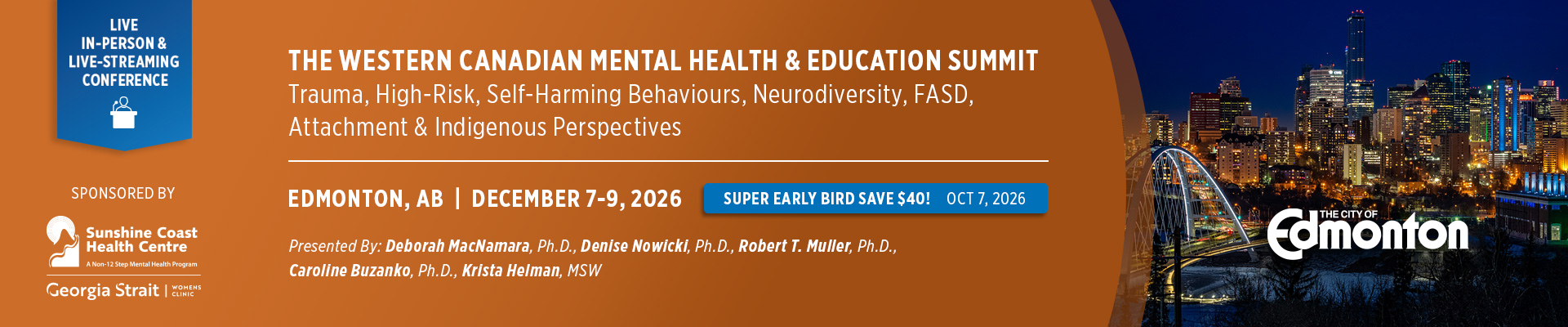
The Western Canadian Mental Health & Education Summit: Trauma, Attachment, High Risk and Self-Harming Behaviours, Neurodiversity and FASD [Edmonton, AB]
Presented by
Deborah MacNamara, Ph.D.
and Denise Nowicki, Ph.D., B.Ed., B.Sc.
and Robert T. Muller, Ph.D., C. Psych.
and Caroline Buzanko, Ph.D., R. Psych
and Krista Helman, MSW
Monday, December 7, 2026 – Wednesday, December 9, 2026
|
Edmonton, ab
Date & Location
Monday, December 7, 2026 – Wednesday, December 9, 2026
8:30am – 4:00pm
Holiday Inn Express Edmonton Downtown
10010 104 Street NW, Edmonton, AB T5J 0Z1
phone: 780.423.2450
Who Should Attend
Education and Clinical Professionals: All education and mental health or healthcare professionals who work with children or youth including, but not limited to K–12 Classroom Teachers, School Counsellors, Learning Assistance/Resource Teachers, School Administrators, School Paraprofessionals including Special Education Assistants, Classroom Assistants and Childcare Workers • All other professionals who support behavioural challenges and complex learning needs including but not limited to: Nurses, Social Workers, Psychologists, Clinical Counsellors, Family Therapists, Occupational Therapists, Speech Language Pathologists, Addiction Counsellors, Youth Workers, Mental Health Workers, Probation Officers and Community Police Officers.
Day One – December 7, 2026
1. Moving Beyond Behaviour Management in Complex Kids: Supporting Resilience and Growth Through a Developmental and Relational Lens
Presented by
Deborah MacNamara, Ph.D.
8:30am - 4:00pm December 7, 2026
WORKSHOP DESCRIPTION
Children’s behaviour is often approached through the lenses of compliance, symptom management, behavioural intervention, or diagnosis. Yet many of the children we struggle most to help are not simply behaving badly — they are alarmed, developmentally stuck, emotionally defended, disconnected, overwhelmed, or adapting to conditions that have interfered with healthy growth.
Without understanding the roots beneath the behaviour, interventions can become reactive, fragmented, or focused only on managing symptoms rather than supporting long-term development and well-being.
This practical and clinically focused full-day presentation offers educators, counsellors, mental health professionals, youth workers, and helping professionals a deeper framework for understanding complex children and youth through a developmental and relational lens. Grounded in attachment theory, developmental science, emotional health, and relational practice, participants will learn how to move beyond surface behaviours to better understand the child underneath.
The workshop will explore three foundational developmental domains that shape children’s functioning and behaviour:
- attachment and relationship
- emotional health and emotional defenses
- maturation and developmental readiness
Together, these domains provide a developmental snapshot that helps reveal whether a child is growing well, adapting under stress, developmentally delayed, emotionally defended, alarmed, or struggling to mature.
Participants will learn how to use this developmental-relational framework to better understand common challenges including aggression, anxiety, attention difficulties, emotional dysregulation, shutdown, opposition, peer problems, school struggles, and relational resistance. Rather than asking, “How do we stop the behaviour?”, this approach asks deeper questions:
- What is the behaviour communicating?
- What developmental needs are driving the problem?
- What emotions are shaping the child’s functioning?
- Is development unfolding naturally, or has it become disrupted or stuck?
- What conditions are needed to support growth and change?
This highly applied workshop bridges theory and practice through real-life examples, guided reflection, practical application, and a live case consultation demonstrating how developmental-relational understanding can be translated into meaningful intervention and support planning across educational, counselling, caregiving, and mental health settings.
Participants will leave with greater confidence in understanding complex children from the inside out and in applying developmental and relational principles to everyday practice with the children and youth in their care.
Show more
Participants will be able to:
- Understand the foundations of a developmental and relational approach to working with children and youth
- Recognize how attachment, emotion, alarm, and maturation shape behaviour and functioning
- Move beyond symptom-focused and behavioural interpretations toward deeper developmental understanding
- Identify signs of developmental stuckness, emotional defenses, alarm, and relational distress
- Understand how behaviour often reflects adaptation, unmet developmental needs, or developmental immaturity
- Learn how to assess children through three foundational domains: attachment, emotional functioning, and maturation
- Develop greater skill in developmental-relational case conceptualization
- Explore practical implications for intervention, caregiving, counselling, education, and support planning
- Apply developmental-relational principles to real-life practice situations and case examples
- Observe how insight-based approaches can be translated into meaningful action through a live case consultation
- Gain greater confidence in supporting complex, vulnerable, and hard-to-reach children and youth
- Understand how creating the right relational and developmental conditions supports resilience, growth, and full human potential

Deborah MacNamara, PhD is a clinical counsellor and educator with more than 25 years’ experience working with children, youth, and adults. She is on faculty at the Neufeld Institute, operates a counselling practice, and speaks regularly about child and adolescent development…
→ Read more
More information: www.neufeldinstitute.org/person/deborah-macnamara/
2. Trauma & Grief 101: What Every Helping Professional Needs to Know
Presented by
Krista Helman, MSW
8:30am - 4:00pm December 7, 2026
WORKSHOP DESCRIPTION
Children and youth encounter trauma and grief in many forms, yet these experiences do not always look the way we expect. Rather than expressing distress through words, children often communicate through their behaviour, emotions, relationships, learning, and physical symptoms. Without a trauma- and grief-informed understanding, these responses can easily be misunderstood or misinterpreted.
Designed for educators, school-based professionals, healthcare providers, mental health clinicians, and other helping professionals who support children and youth, this engaging and practical workshop provides a strong foundation for understanding how trauma and grief influence development, behaviour, learning, and emotional well-being.
Participants will explore the differences between trauma, grief, loss, and bereavement while examining how developmental stage shapes a child’s understanding of adversity, relationships, and death. Through an accessible overview of the developing brain and nervous system, participants will gain insight into why children and youth respond the way they do and how these responses often represent adaptive survival strategies rather than intentional misbehaviour.
Using research-informed content, real-life examples, case studies, demonstrations, humour, and interactive discussion, participants will learn to recognize common trauma and grief responses across developmental stages and apply practical strategies that foster safety, connection, co-regulation, emotional regulation, and resilience in everyday interactions.
Participants will leave with greater confidence in responding compassionately and effectively to children and youth experiencing trauma or grief, while understanding the importance of working within their professional role and recognizing when additional supports or referrals may be needed. The workshop also highlights practical strategies for maintaining personal well-being and reducing the impact of compassion fatigue, vicarious trauma, and burnout, empowering helping professionals to continue supporting others with confidence, empathy, and resilience.
Show more
LEARNING OBJECTIVES
- Differentiate between trauma, grief, loss, and bereavement and recognize how these experiences may overlap in the lives of children and youth.
- Explain how trauma and grief influence the developing brain, nervous system, emotions, behaviour, learning, relationships, and daily functioning.
- Recognize how developmental stage influences children’s and youths’ trauma and grief responses, including behaviours that are frequently misunderstood.
- Apply practical trauma-informed and grief-informed strategies that foster safety, connection, co-regulation, emotional regulation, and resilience.
- Respond with greater confidence and compassion to children, youth, and families while recognizing scope of practice and when additional supports or referrals are appropriate.
Identify practical strategies that promote resilience and reduce the impact of compassion fatigue, vicarious trauma, and burnout.

Krista Helman, MSW is a Registered Social Worker in Ontario and a Registered Clinical Social Worker in British Columbia. She is the Founder and Executive Director of the Trauma & Grief Institute, an author, international speaker, and clinical educator specializing…
→ Read more
Day Two – December 8, 2026
3. Supporting Neurodivergent Learners: Understanding Autism Spectrum Disorder Through a Strength-Based Lens
Presented by
Denise Nowicki, Ph.D., B.Ed., B.Sc.
8:30am - 4:00pm December 8, 2026
WORKSHOP DESCRIPTION
Autism Spectrum Disorder (ASD) is a neurodevelopmental difference that influences how individuals experience, process, and interact with the world around them. While autistic individuals possess strengths, talents, and unique perspectives, they are often misunderstood in educational and counselling settings. Behaviours that may appear oppositional, withdrawn, rigid, or socially inappropriate are frequently rooted in differences in communication, sensory processing, emotional regulation, executive functioning, and social understanding rather than a lack of motivation or willingness.
This engaging and practical workshop helps educators and counsellors move beyond stereotypes and develop a deeper understanding of Autism Spectrum Disorder through a strengths-based, neurodiversity-affirming lens. Participants will learn to recognize common indicators of ASD, understand how autism may present differently across individuals and age groups, and explore practical strategies that promote inclusion, belonging, emotional well-being, and success.
Through interactive activities, case studies, simulations, and reflective discussions, attendees will gain tools to better support autistic students and clients while fostering compassionate, meaningful relationships.
Show more
LEARNING OBJECTIVES
- Understand the characteristics, diversity, and strengths associated with Autism Spectrum Disorder (ASD).
- Recognize common indicators of ASD across age groups and settings.
- Reframe behaviours through a neurodevelopmental and neurodiversity-affirming lens.
- Apply practical strategies that support communication, emotional regulation, learning, and participation for neurodiverent learners.
- Build capacity in autistic individuals by fostering self-awareness, self-advocacy, independence, and adaptive skills that support long-term success and well-being.
- Foster supportive, respectful, and inclusive relationships that promote belonging and well-being.

For more than 30 years, I have worked as an educator across K–12 and post-secondary settings, as a teacher, principal, and registered psychologist. Throughout my career, I have been committed to supporting learning, mental health, and well-being across the lifespan.…
→ Read more
4. Therapeutic Relationship Strategies to Treat Challenging Trauma Clients
Presented by
Robert T. Muller, Ph.D., C. Psych.
8:30am - 4:00pm December 8, 2026
WORKSHOP DESCRIPTON
This practical workshop, led by Dr. Robert T. Muller, author of psychotherapy bestsellers, “Trauma & the Struggle to Open Up,” as well as “Trauma & the Avoidant Client” , builds our understanding of the therapeutic relationship with challenging trauma clients.
As therapists, we try to maintain a strong therapeutic relationship, but this is easier said than done. Drawing on attachment theory and research, and using a relational, integrative approach, the workshop follows the ups and downs of the therapy relationship in trauma work. We look at choices therapists make in navigating the process, examining how they affect outcome.
Specifically, we look at relationship patterns in trauma work, and how these can lead to troubling therapist-client enactments. When left unchecked, such patterns lead to ruptures in the relationship. In trauma work, how do we repair a ruptured alliance? And how can we help clients grow from the experience? This workshop looks at such issues in detail.
Theory is complemented by case examples and therapy segments. We draw particularly from Dr. Muller’s book, Trauma and the Struggle to Open Up, winner of the 2019 ISSTD award for the year’s best written work on trauma.
Show more
LEARNING OBJECTIVE
- Use an attachment theory framework in relational trauma work
- Recognize therapist-client relationship patterns in trauma treatment
- Consider their own (therapist’s) feelings in the therapeutic process (e.g. the wish to rush into trauma work, or the wish to avoid it)
- Notice problematic relational enactments
- Navigate conflicts and relational ruptures to get treatment back on track
- Use conflicts and relational ruptures to bring about posttraumatic growth

Robert T. Muller, Ph.D., C.Psych. is on faculty as a Full Professor of Clinical Psychology at York University, is a Fellow of the International Society for the Study of Trauma & Dissociation (ISSTD); and both of his books have won…
→ Read more
Day Three – December 9, 2026
5. Working with Children and Youth who are High-Risk, Marginalized and Engage in Self-Harming Behaviour
Presented by
Caroline Buzanko, Ph.D., R. Psych
8:30am - 4:00pm December 9, 2026
WORKSHOP DESCRIPTION
For anyone who know that “safety contracts” don’t work and want to know what does. Self-harm among youth isn’t rising because young people are more fragile. It’s rising because the conditions they’re navigating create psychological states where harming one’s own body makes functional sense. This intensive 6-hour workshop is designed for anyone who work with the youth carrying the heaviest burdens: those at the intersection of marginalization, trauma, and self-injury.
You’ll move beyond risk management checklists to understand the why beneath the behaviour. Drawing on the established theories and evidence-based interventions for self-harm, this training provides the clinical precision needed when the stakes are highest.
This workshop addresses the reality that therapy fails when it replicates the same power dynamics that harm youth in the first place. You’ll learn how to structure engagement that honours adolescent autonomy, conduct chain analyses that reveal intervention points invisible in standard assessments, and teach physiological regulation skills that work when cognitive strategies fail. We’ll tackle the specific dialectical dilemmas of adolescent treatment: how to involve parents without breaking confidentiality, how to validate pain without reinforcing dysfunction, and how to adapt evidence-based protocols for youth who experience standard therapeutic language as minimizing and unhelpful.
You’ll also confront the parts of this work that textbooks skip: how to stay regulated when a 14-year-old shows you fresh burns, how to respond when a family’s exhaustion manifests as rage, and how to maintain therapeutic boundaries while practicing the “moral courage” required to witness historical trauma.
This workshop is key to develop enough technical skill and relational capacity that young people choose to stay alive long enough to discover they want to.
WORKSHOP OUTLINE
Module 1: Understanding Self-Harm Through Intersectional and Biosocial Frameworks
- Personal mapping
- The crisis in context
- Biosocial theory
- Ecology of marginalization
- Developmental versus pathological
- Under-regulation versus over-regulation
Module 2: Engagement, Assessment, and Building Alliance Across Difference
- Why youth hide
- Trauma-informed engagement
- Beyond tick-box assessment
- Structural engagement for autonomy
- Cultural safety strategies
- Fidelity versus flexibility
Module 3: Core Clinical Skills—The Technical Architecture of Intervention
- The “Power Tools” of DBT-A
- Crisis survival skills
- Dialectical thinking & function question
Module 4: Safety Planning, Family Systems, and Ethical Harm Reduction
- Collaborative safety planning
- Harm reduction strategies
- Family systems and the middle path
- Systemic context
Closing: Develop an implementation plan for one current high-risk client
Show more
LEARNING OBJECTIONS
- Analyze intersectional risk through biosocial and structural lenses
- Differentiate self-harm typology and match intervention to regulation profile
- Deploy crisis-specific physiological regulation skills
- Conduct behavioural chain analysis to identify micro-intervention points
- Navigate adolescent-family dialectical dilemmas
- Implement culturally responsive adaptations without compromising fidelity

Caroline Buzanko, Ph.D., R. Psych, is a psychologist. Mother. Professor. International Speaker. Yoda of Anxiety. ADHD Superhero. And Changer of Lives. With nearly three decades of experience, she is a recognized expert in resilience and the social, emotional, and behavioural well-being…
→ Read more
6. Fetal Alcohol Spectrum Disorder: Reframing Behaviours to Support Strengths and Promote Success
Presented by
Denise Nowicki, Ph.D., B.Ed., B.Sc.
8:30am - 4:00pm December 9, 2026
WORKSHOP DESCRIPTION
Did you know that Fetal Alcohol Spectrum Disorder (FASD) is one of the most common neurodevelopmental disabilities in Canada, affecting an estimated 4% of the population (CanFASD, 2024)? Despite its prevalence, FASD often goes unrecognized or misunderstood, leaving those working with these individuals wondering why traditional strategies are not working and why some continue to struggle despite their best efforts.
Join us for an engaging and practical presentation designed specifically for those working with challenging children and youth who want to better understand, identify, and support individuals with FASD. This session moves beyond labels and challenges us to dig deeper into behaviour to understand the brain-based differences that influence learning, emotional regulation, social interactions, and executive functioning.
Participants will learn about the prevalence and characteristics of FASD, common signs that may indicate an individual is struggling with neurodevelopmental challenges, and the impact these differences can have on individuals across the lifespan. Most importantly, we will explore how reframing our perspective—from asking “What’s wrong with this individual?” to “What does this individual need to succeed?”—can transform relationships, reduce frustration, and improve outcomes for both the individuals impacted by FASD and those working with them.
This presentation emphasizes a strengths-based, compassionate approach that recognizes the unique abilities, creativity, resilience, and potential of individuals with FASD. By understanding how the brain works and adapting our expectations and supports accordingly, attendees will leave with practical strategies to create supportive environments, foster positive behaviour, and build meaningful connections that help students thrive.
Whether you are a classroom teacher, educational assistant, administrator, counsellor, or support professional, this session will provide valuable insights and tools that can be applied immediately in educational settings.
Together, we can move beyond behaviours, recognize hidden strengths, and create communities where individuals with FASD are understood, supported and empowered to thrive.
Show more
Registration & Fees
| Registration |
Super Early Bird Fee |
Early Bird Fee |
Regular Fee |
| ONE DAY ENROLLMENT |
--
|
|
|
| Individual 1 Day Enrollment |
$279.00 |
$299.00 |
$319.00 |
| 1 Day Group 3-7 |
$229.00 |
$249.00 |
$269.00 |
| 1 Day Group 8-14 |
$209.00 |
$229.00 |
$249.00 |
| 1 Day Group 15+ |
$189.00 |
$209.00 |
$229.00 |
| 1 Day Full-Time Student |
$189.00 |
$209.00 |
$229.00 |
|
--
|
|
|
| TWO DAY ENROLLMENT |
--
|
|
|
| Individual 2 Day Enrollment |
$499.00 |
$519.00 |
$539.00 |
| 2 Day Group 3-7 |
$459.00 |
$469.00 |
$489.00 |
| 2 Day Group 8-14 |
$429.00 |
$449.00 |
$469.00 |
| 2 Day Group 15+ |
$399.00 |
$419.00 |
$439.00 |
| 2 Day Full-Time Student |
$399.00 |
$419.00 |
$439.00 |
|
--
|
|
|
| THREE DAY ENROLLMENT |
--
|
|
|
| Individual 3 Day Enrollment |
$669.00 |
$689.00 |
$699.00 |
| 3 Day Group 3-7 |
$619.00 |
$639.00 |
$659.00 |
| 3 Day Group 8-14 |
$599.00 |
$619.00 |
$629.00 |
| 3 Day Group 15+ |
$469.00 |
$489.00 |
$509.00 |
| 3 Day Full-Time Student |
$469.00 |
$489.00 |
$509.00 |
All fees are per person and in Canadian Dollars ($CAD)
Fees do not include applicable taxes (5% GST).
Super early bird cutoff date: October 7, 2026
To receive the super early bird rate, registration and payment must be received by Wednesday, October 7, 2026.
Early bird cutoff date: November 7, 2026
To receive the early bird rate, registration and payment must be received by Saturday, November 7, 2026.
Register Online Register your Group
Downloads
All brochures and forms are provided in .PDF format.
If you are unable to open our files, we recommend downloading Adobe Reader for free.
Recommended Accommodation
Holiday Inn Express Edmonton Downtown
10010 104 Street NW, Edmonton, AB T5J 0Z1
phone: 780.423.2450
 Full map & directions
Our rates:
Please contact the hotel directly for the best available rates.
Continuing Education Credits
This workshop has been formally approved by the following associations:
† The Alberta College of Social Workers (ACSW) and the Newfoundland and Labrador Association of Social Workers (NLASW) accept CPA-approved CEUs.
* Participants will receive a certificate of completion after every workshop. Workshops are pre-approved for 5.5 or 6 credits per day unless otherwise specified.
Please check back closer to the conference date for more information.
Related Events
There are no related events at this time.